
AI Strategy & Business Transformation
AI tools are becoming easier to access, cheaper to deploy and more powerful every day. But choosing an AI tool is not the same as having an AI strategy. Businesses that want sustainable value from artificial intelligence need to first understand where AI can create measurable business impact, which use cases should be prioritized, what data and technology foundations are required, and how those solutions can scale.
should create business value.
AI Tools Are Not an AI Strategy
A business can have access to ChatGPT, AI copilots, automation platforms, AI chatbots, machine learning models and AI agents without having a clear plan for using them. That is where many organizations encounter a problem: AI adoption starts before AI direction is defined.
The result can be a collection of disconnected pilots, duplicated tools, inconsistent data practices, security concerns and difficulty proving return on investment.
Recent enterprise research reflects this challenge. McKinsey’s 2025 State of AI survey found that nearly two-thirds of respondents said their organizations had not yet begun scaling AI across the enterprise, even though AI adoption was already widespread. The question for business leaders therefore shouldn’t simply be:
“Which AI tool should we use?”
A better question is:
“Where can AI create meaningful, measurable and scalable value for our business?”
AI Tools Are Not an AI Strategy
A business can have access to ChatGPT, AI copilots, automation platforms, AI chatbots, machine learning models and AI agents without having a clear plan for using them. That is where many organizations encounter a problem: AI adoption starts before AI direction is defined. The result can be a collection of disconnected pilots, duplicated tools, inconsistent data practices, security concerns and difficulty proving return on investment. Recent enterprise research reflects this challenge. McKinsey’s 2025 State of AI survey found that nearly two-thirds of respondents said their organizations had not yet begun scaling AI across the enterprise, even though AI adoption was already widespread. :contentReference[oaicite:1]{index=1}
The question for business leaders therefore shouldn’t simply be:
“Which AI tool should we use?”
A better question is:
“Where can AI create meaningful, measurable and scalable value for our business?”
AI Strategy vs AI Tools: What’s the Difference?
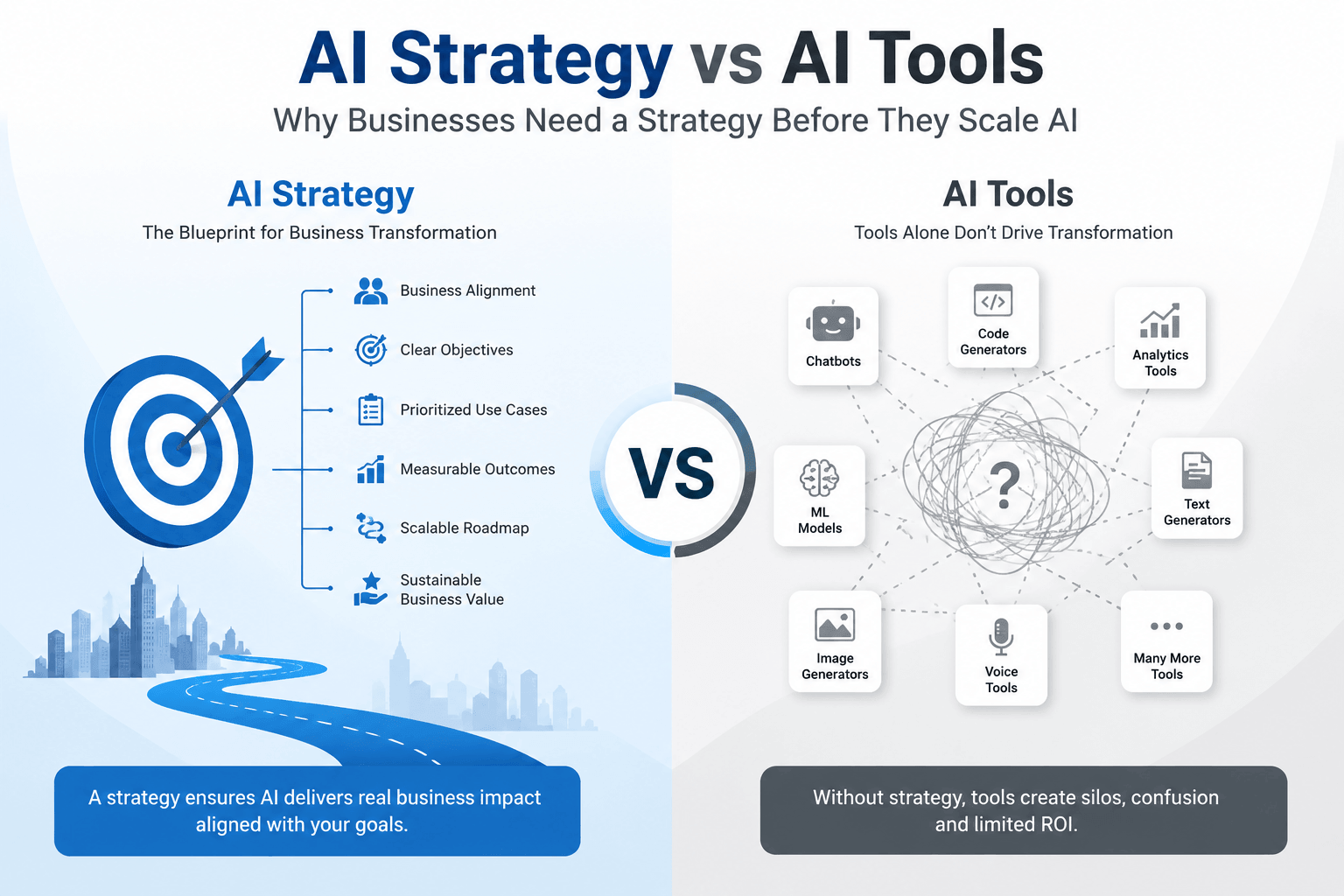
AI tools are technologies that help organizations perform specific tasks. An AI strategy defines how an organization should use artificial intelligence to achieve business objectives.
| AI Tool-First Approach | AI Strategy-First Approach |
|---|---|
| Which AI tool should we buy? | Which business problem should AI solve? |
| Focuses on technology features | Focuses on measurable business outcomes |
| Starts with a tool or model | Starts with business objectives |
| Often creates isolated pilots | Creates a prioritized AI roadmap |
| Technology-led decision making | Business + technology decision making |
| May optimize individual tasks | Can transform complete workflows |
| ROI may be difficult to measure | KPIs and value measurement are defined upfront |
| Can lead to disconnected AI initiatives | Designed for governance, integration and scale |
The Problem With a Tool-First AI Approach
AI technology is moving quickly. New models, platforms and AI agents appear constantly. This creates an understandable temptation for businesses to adopt the latest technology as soon as it becomes available. But technology adoption without a clear strategy can create several problems.
1. Too Many AI Experiments
Different departments may start using different AI tools for similar tasks. Marketing may adopt one platform, customer support another, developers another, and operations another. Individually, these tools may work well. Collectively, they can create an increasingly fragmented AI environment.
2. Unclear Business Value
An AI proof of concept can demonstrate that something is technically possible. That does not automatically mean it is commercially valuable. Before scaling an AI initiative, organizations should understand what business metric it is expected to improve.
3. Data and Integration Challenges
AI applications rarely operate in isolation. They often need access to enterprise data, APIs, CRM platforms, ERP systems, documents, databases and internal workflows. Without the right architecture and data foundation, an impressive AI prototype can become difficult to operate at enterprise scale.
4. Security and Governance Risks
As AI moves deeper into business processes, organizations must consider data privacy, access control, model behavior, auditability, security, regulatory requirements and human oversight.
IBM’s 2026 research highlights this shift: organizations are increasingly dealing with governance, security and operational challenges as AI deployments move beyond isolated experiments and toward enterprise scale. :contentReference[oaicite:2]{index=2}
5. Difficulty Scaling Successful Pilots
A successful pilot does not automatically become a successful enterprise solution. Scaling requires architecture, integration, data pipelines, security, monitoring, governance, user adoption and ongoing optimization.
AI Adoption Is Moving From Experimentation to Scale
The AI conversation is changing. Businesses are moving beyond asking whether AI can perform a particular task and are increasingly asking how AI can be embedded into business operations.
McKinsey’s 2025 research found that while AI adoption is widespread, most organizations are still in the early stages of scaling AI and capturing enterprise-level value. :contentReference[oaicite:3]{index=3}
Experiment
Explore AI capabilities
Pilot
Validate selected use cases
Strategize
Prioritize business value
Implement
Build and integrate AI
Scale
Expand across workflows
How Leading AI and Technology Companies Approach Enterprise AI
The difference between buying technology and creating business value is increasingly recognized across the enterprise technology industry.
Major technology and consulting organizations are positioning AI around broader transformation, architecture, governance and measurable outcomes rather than treating AI as a standalone tool. For example, Accenture’s technology strategy offering emphasizes aligning technology with business growth, competitiveness and innovation, while its AI services focus on moving from isolated use cases toward value-led approaches across the enterprise. :contentReference[oaicite:4]{index=4} IBM similarly emphasizes the systems surrounding AI—including data, infrastructure, governance and operating models—as critical components of successful enterprise AI adoption. :contentReference[oaicite:5]{index=5} This points to an important lesson for businesses:
Enterprise AI is not simply a software purchase. It is a business transformation
initiative.
The opportunity for organizations is therefore not to collect more AI tools. It is to build a structured approach for deciding which AI capabilities deserve investment, how they should be implemented and how their value should be measured.
What Should Your Business Do Instead?
At Stigasoft, we believe AI adoption should begin with the business problem—not with
the technology.
Instead of asking a business to start with a particular AI model, platform or tool,
the first step should be understanding the organization, its processes, its customers,
its technology environment and its growth objectives.
Our AI Strategy Approach
Understand Your Business
We begin by understanding your business objectives, operational processes,
customer journeys, existing technology stack and the challenges your teams
actually face.
Identify AI Opportunities
We identify areas where artificial intelligence can potentially improve
productivity, customer experience, decision-making, automation, revenue,
operational efficiency or risk management.
Prioritize AI Use Cases
Not every AI opportunity deserves investment. We help prioritize initiatives
based on potential business impact, technical feasibility, data readiness,
cost, risk and scalability.
Define the AI Roadmap
Instead of implementing disconnected AI projects, we create a practical roadmap
that can move from quick wins to strategic initiatives and eventually to
enterprise-scale AI adoption.
Select the Right Technology
Only after the business requirements are clear should technology choices be
made. Depending on the use case, the solution may involve generative AI,
machine learning, AI agents, retrieval-augmented generation, computer vision,
predictive analytics, intelligent automation or custom AI applications.
Build and Integrate
Strategy should not end with a presentation or roadmap. The next step is
turning the strategy into working technology by developing AI solutions and
integrating them with the systems your business already uses.
Measure and Optimize
AI initiatives should have measurable objectives. Depending on the use case,
these could include reduced processing time, lower operational costs,
improved conversion rates, increased productivity, faster customer response,
improved accuracy or new revenue opportunities.
From AI Strategy to AI Implementation
The biggest difference between having an AI strategy and actually creating business
value is execution.
A strategy should provide a clear path from business objectives to technology
implementation.
What are we trying to achieve?
Where can AI create value?
What should we do first?
How should we scale?
How do we implement it?
Is it creating value?
Where Can an AI Strategy Create Business Value?
An AI strategy should not be limited to chatbots or generative AI content.
Depending on the organization, AI can support multiple business functions.
Customer Experience
AI-powered customer support, intelligent assistants, personalization,
recommendation systems and automated responses.
Business Operations
Workflow automation, document processing, intelligent task management and
operational decision support.
Sales & Marketing
Lead intelligence, customer segmentation, content assistance, predictive
analytics and sales enablement.
Software Engineering
AI-assisted development, code analysis, testing automation, documentation and
developer productivity.
Data & Analytics
Predictive analytics, intelligent reporting, anomaly detection and
AI-powered decision support.
Enterprise Knowledge
Intelligent search, knowledge assistants, RAG-based systems and AI interfaces
for internal organizational knowledge.
AI Agents Make Strategy Even More Important
The next phase of enterprise AI is increasingly moving beyond simple question-and-answer
interfaces toward AI systems that can coordinate tasks, interact with applications and
support multi-step workflows.
This makes strategy even more important.
When AI can influence or execute business processes, organizations need to understand
not only what the technology can do, but also where it should be allowed to act,
what data it can access, when humans should remain involved and how its actions should
be monitored.
IBM’s 2026 research notes that organizations are moving toward agentic AI while facing
increasing challenges around governance, security and control. :contentReference[oaicite:6]{index=6}
Therefore, the move from AI tools to AI agents is not simply a technology upgrade.
It is an operating-model decision.
How Should Businesses Measure AI ROI?
One of the biggest mistakes businesses can make is measuring AI success by the number
of AI tools deployed.
The better question is whether the AI initiative improves a meaningful business metric.
Hours saved per employee or process
Reduction in operational or processing costs
Additional revenue or conversion improvement
Faster responses and improved satisfaction
Improved accuracy and reduced errors
Reduced turnaround and decision time
This value-led approach is consistent with the broader enterprise AI shift toward
measuring business outcomes rather than simply counting AI deployments.
What Stigasoft Can Do for Your Business
Businesses don’t necessarily need another AI tool. They need a partner that can help
connect business objectives with practical technology.
Stigasoft can help organizations move through the AI journey from identifying
opportunities to building and integrating the right solution.
AI Opportunity Assessment
Identify processes and business areas where AI can create meaningful value.
AI Strategy & Roadmap
Define priorities, use cases, technology direction and a phased implementation
roadmap.
AI Solution Architecture
Design the technical architecture, data flows, integrations and AI components
required for the solution.
Custom AI Development
Build AI-powered applications, intelligent workflows, assistants, automation
solutions and enterprise AI systems.
AI Integration
Connect AI capabilities with existing enterprise applications, APIs, databases
and business workflows.
AI Optimization & Scaling
Monitor performance, improve workflows, strengthen governance and scale
successful AI initiatives across the organization.
Don’t Start With the AI Tool. Start With the Business Problem.
The AI landscape will continue to change. Today’s leading model or platform may be replaced by something better tomorrow. Your business strategy, however, should not depend on a single AI tool. A strong AI strategy creates a technology-independent framework for identifying opportunities, prioritizing investments, managing risk and continuously adapting to new AI capabilities.
The goal is not to use more AI. The goal is to use AI where it can create more value.
AI Strategy Is the Foundation for Scalable AI
AI tools can help businesses automate tasks, generate content, analyze information and improve productivity. But tools alone do not create an enterprise AI strategy. To scale AI successfully, organizations need a clear understanding of their business objectives, prioritized use cases, reliable data, appropriate technology architecture, security and governance, measurable KPIs and a practical implementation roadmap.
The strongest AI initiatives connect all of these elements. That’s where Stigasoft’s approach comes in. Rather than starting with a technology and looking for a problem to solve, we help businesses identify where AI can create value, define the right strategy and turn that strategy into practical, scalable technology.
Ready to Move From AI Experimentation to AI Execution?
Let’s identify where AI can create measurable value for your business and build a practical roadmap to take it from idea to implementation.
Connect with us
Frequently Asked Questions About AI Strategy
What is an AI strategy?
An AI strategy is a structured plan that defines how an organization will use
artificial intelligence to achieve business objectives. It typically covers AI
opportunities, use-case prioritization, data readiness, technology architecture,
governance, implementation and measurement.
Why do businesses need an AI strategy?
An AI strategy helps businesses prioritize the right use cases, avoid disconnected
technology investments, manage risks, align AI with business goals and create a
roadmap for scaling successful initiatives.
What is the difference between AI tools and AI strategy?
AI tools provide specific technological capabilities. An AI strategy determines
where, why and how those capabilities should be used to achieve measurable business
outcomes.
Should a company build or buy AI solutions?
The answer depends on the business requirement, existing technology environment,
data, security requirements, expected scale, cost and time to value. A strategy
should evaluate these factors before deciding whether to use an existing tool,
integrate a platform or build a custom AI solution.
Can Stigasoft help with AI implementation as well as strategy?
Yes. Stigasoft can help businesses move from AI opportunity identification and
strategy to solution architecture, custom AI development, integration,
implementation and optimization.
How should businesses measure AI success?
AI success should be measured against business outcomes such as productivity,
cost reduction, revenue, customer experience, processing time, accuracy,
operational efficiency or other KPIs relevant to the specific use case.