At Stigasoft, we recognize that a solution may only be a vision in the customers mind and that all requirements cannot always be thought out and planned at the outset. The process therefore requires constant interaction between Stigasoft and the customer, to provide feedback from both sides about how the project is going.
Learn More Business Excellence Methodology Explore


Scrum is an agile process most commonly used for product development, especially software development. Scrum is a project management framework that is applicable to any project with aggressive deadlines, complex requirements and a degree of uniqueness. In Scrum, projects move forward via a series of iterations called sprints. Each sprint is typically two to four weeks long.
The main phases of a project are Planning, Project Incremental Development, Incremental Deployment and Project Closing. The Incremental Development stage is organized into consecutive Sprints or iterations where different tasks are carried out to implement a set of requirements.

As the project starts, the team is formed and planning activities take place to organize the work, this is called Iteration Zero. The Release planning includes the requirement gathering and fully understanding of the expectation of the customer. A product backlog is created, with the list of product requirements. The technical vision is documented and a high level system architecture and design are established.

Agreement within the team and with the customer, as to what needs to be completed for a product to be finished.

Discussions between the project team and the client to define what users actually want out of the product and the priorities.

The types of testing that will be used for each product.

Estimation of timing to release a product.
The work is organized into a living backlog: the list of requirements or user stories. The backlog is prioritized by the Product Owner according to business needs. The goal is to deliver first what it is the most valuable to the Client, to get the best ROI.


The work is organized into a living backlog: the list of requirements or user stories. The backlog is prioritized by the Product Owner according to business needs. The goal is to deliver first what it is the most valuable to the Client, to get the best ROI.


The work is organized into a living backlog: the list of requirements or user stories. The backlog is prioritized by the Product Owner according to business needs. The goal is to deliver first what it is the most valuable to the Client, to get the best ROI.


The work is organized into a living backlog: the list of requirements or user stories. The backlog is prioritized by the Product Owner according to business needs. The goal is to deliver first what it is the most valuable to the Client, to get the best ROI.
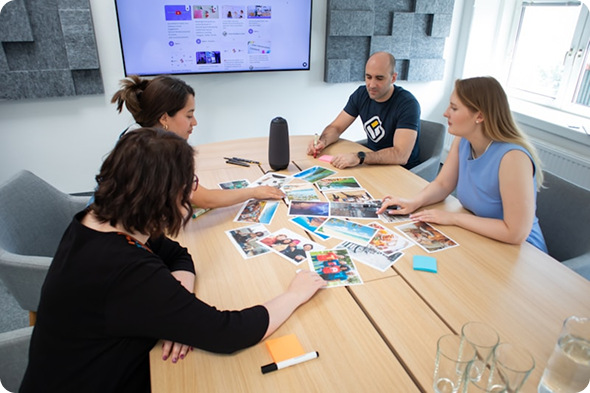

The work is organized into a living backlog: the list of requirements or user stories. The backlog is prioritized by the Product Owner according to business needs. The goal is to deliver first what it is the most valuable to the Client, to get the best ROI.

Global Clients Worldwide